
3 Patti Sequence: Pure Sequence, Sequence and Examples
Reviewed by Fahad Ali — Senior Content Strategist & Forensic Analyst at VerifiedAPKs
Understanding the 3 patti sequence is the most critical mathematical skill required to master the game. Because players are dealt exactly three cards, consecutive numerical combinations hold immense power at the final showdown. Before diving into advanced table mechanics or exploring the full Teen Patti Rules: Complete 3 Patti Rules for Beginners, you must know exactly how to evaluate your connected cards.

3 Patti Gold APK
Security AlertDoes the 111 PKR sign-up bonus actually pay out? Read our forensic audit of the uncertified RNG algorithms and JazzCash withdrawal traps.
Read Full App Audit →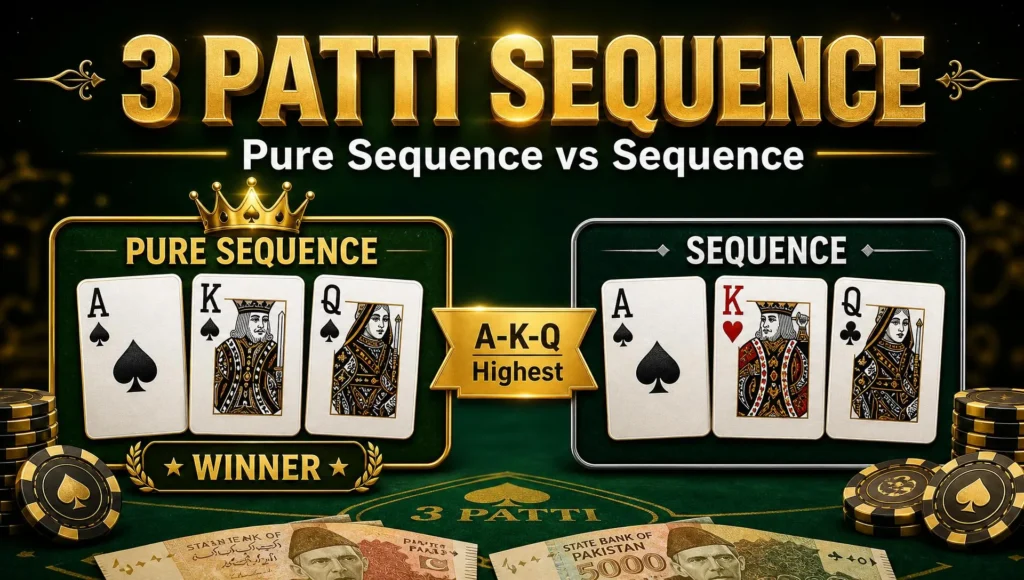
What is a Sequence in Teen Patti?
A sequence in teen patti (often referred to as a Normal Sequence, Straight, or Kacchi Run) consists of three cards arranged in consecutive numerical order, but containing mixed suits.
To form a valid 3 card sequence, the numbers must connect directly (for example, 7, 8, and 9). The suits do not matter for a normal sequence. You might hold a Spade, a Heart, and a Diamond. Because drawing three connecting numbers out of a 52-card deck is mathematically challenging, this hand tier holds significant strength against common table distributions.
Examples of a Normal Sequence:
- 9♠ 8♦ 7♥
- 5♣ 4♠ 3♦
- Q♥ J♣ 10♠
What is a Pure Sequence in 3 Patti?
A pure sequence in 3 patti (also known as a Straight Flush or Pakki Run) is a vastly superior combination. It requires three cards in consecutive numerical order that all belong to the exact same suit.
The teen patti pure sequence is the second-highest hand achievable in the standard game. It is exceptionally rare because you must align both numerical order and exact suit consistency simultaneously.
Examples of a Pure Sequence:
- 9♠ 8♠ 7♠ (All Spades)
- 5♦ 4♦ 3♦ (All Diamonds)
- Q♣ J♣ 10♣ (All Clubs)
Difference Between Sequence and Pure Sequence
The distinction between these two combinations dictates your entire table strategy and confidence level when staking your chips.
- Suit Consistency: A normal sequence mixes suits (e.g., Spades, Hearts, Clubs). A pure sequence demands identical suits.
- Hand Hierarchy: A pure sequence strictly outranks a normal sequence. If Player A reveals the highest possible normal sequence and Player B reveals the lowest possible pure sequence, Player B takes the entire pot.
- Mathematical Probability: You have a 3.26% chance of drawing a normal sequence from a shuffled deck, making it an uncommon but reachable goal. You have only a 0.22% chance of drawing a pure sequence, making it one of the rarest events in the game.

3 Patti Boss APK
Audit ReadyWant to see these withdrawal traps in action? Read our complete forensic security breakdown and payout test.
Read Full Review →3 Patti Sequence Order: Which Sequence is Higher?
When multiple players reach the final showdown holding consecutive runs, the 3 patti sequence order relies on the numerical face value of the highest card in the run. Suits carry equal weight; they do not break ties.
Here is the definitive ranking of 3 patti cards sequence hierarchies, from highest to lowest:
1. A-K-Q (The Highest Sequence)
An Ace, King, and Queen form the absolute highest consecutive run.
- As a Pure Sequence: A♠ K♠ Q♠ is the strongest pure sequence possible.
- As a Normal Sequence: A♦ K♣ Q♠ is the strongest normal sequence possible.
2. A-2-3 (The Second Highest Sequence)
In standard traditional rules across South Asia, the Ace serves a dual purpose. It can act as the highest card (following the King) or the lowest card (preceding the Two).
- An A-2-3 run ranks mathematically as the second-highest sequence.
- It strictly defeats a K-Q-J combination.
3. K-Q-J (The Third Highest)
A King, Queen, and Jack represent the third-strongest run on the board.
- It defeats Q-J-10, J-10-9, and all lower numerical runs.
The Lowest Sequence (4-3-2)
A 4, 3, and 2 combination is the weakest possible sequence. However, even the weakest 3 card sequence still commands massive respect at the table and easily defeats high pairs and standard flushes.

How Sequences Compare Against Other Cards
To evaluate your table position accurately, you must understand how consecutive runs match up against other major hand categories. For a complete breakdown of every single combination, refer to our definitive 3 Patti Hand Rankings guide.
Sequence vs Colour
Does a normal sequence beat a Colour (Flush)? Yes. In standard 3 Patti, a normal sequence strictly defeats a Colour. Because players only receive three cards, drawing three connected numbers (Sequence) is mathematically rarer than drawing three random cards of the same suit (Colour). This is the exact opposite of traditional five-card global rules. If you hold a 4-3-2 sequence of mixed suits, you will defeat an Ace-King-Jack Colour.
Pure Sequence vs Trail
Does a pure sequence beat a Trail (Three of a Kind)? No. A Trail (Trio or Set) is the only hand category that defeats a 3 patti pure sequence. Three identical cards (such as 7-7-7) represent the peak of the game’s hierarchy and hold a lower mathematical probability than a straight flush. If you hold A♠-K♠-Q♠ (the highest pure sequence), you will still lose to 2-2-2 (the lowest Trail).
Mathematical Probability of a Teen Patti Sequence
The entire 3 patti sequence order relies strictly on mathematical probability. When using a standard 52-card deck with all jokers removed, the scarcity of a combination dictates its power at the final showdown.
- Pure Sequence Probability: There are exactly 48 possible ways to draw a pure sequence in 3 patti. This translates to a microscopic 0.22% chance of landing this combination. Because aligning three consecutive numbers in the exact identical suit is so statistically rare, it rightfully stands as the second-highest hand in the game.
- Normal Sequence Probability: There are 720 possible ways to draw a normal sequence in teen patti (mixed suits). This carries a probability of approximately 3.26%.
- The Flush Comparison: By comparison, there are 1,096 ways to draw a standard Colour (Flush), carrying a 4.96% probability. Because it is mathematically easier to draw three cards of the same suit than three consecutive numbers, the normal 3 card sequence universally outranks the Colour.
Strategic Gameplay with a 3 Card Sequence
Holding a strong teen patti sequence requires disciplined chip management. If you reveal your strength too early, opponents will pack (fold), and you will collect a minimal pot.
- Managing a Pure Sequence: If you are dealt a teen patti pure sequence, you possess a near-unbeatable hand. Play blind for the first two rounds if table conditions permit. This forces players who have viewed their cards to commit double the chips to stay active, inflating the central pot before you reveal your dominance.
- Evaluating a Normal Sequence: A normal 3 patti cards sequence like J-10-9 is highly competitive but vulnerable. In a full six-player room, the statistical likelihood of an opponent holding a higher sequence (like A-K-Q or A-2-3) increases. If an opponent aggressively raises the stakes without requesting a sideshow, exercise caution.
- Avoiding Predictor Scams: Never attempt to use third-party “mod APKs” or Telegram prediction scripts to secure a sequence. Game outcomes are calculated on highly encrypted, off-site servers using a Provably Fair algorithm. Fake mod APKs sold by scammers are empty shells containing keyloggers and SMS interceptors designed to drain your actual mobile wallet.
Securing Your Winnings (The CNIC Rule)
If you successfully utilize a sequence to accumulate chips on a digital platform, you must navigate local financial gateways correctly to secure your funds.
- The Name Match Rule: To ensure instant, automated withdrawals, the Account Name you register inside your gaming application must perfectly match the exact legal title on your CNIC that is registered to your Easypaisa, SadaPay, NayaPay, or JazzCash wallet.
- Security Freezes: If your game username is an alias but your Easypaisa is legally registered under your real name, the banking API will reject the transfer. The system flags this as a suspicious third-party transfer, and your money will be frozen for manual review.
- The 1x Turnover Requirement: Platforms enforce a mandatory 1x turnover limit to comply with global Anti-Money Laundering (AML) standards. You must place wagers totaling 100% of your deposit value across game lobbies before withdrawal permissions unlock.
To fully master the mechanics of the table beyond just consecutive runs, explore our comprehensive breakdown of all combinations in the 3 Patti Hand Rankings guide. If you are entirely new to the table format, chip distribution, and player positioning, read our foundational Teen Patti Rules: Complete 3 Patti Rules for Beginners manual to establish your baseline strategy.
Frequently Asked Questions (3 Patti Sequence)
Which is the highest sequence in 3 Patti?
The highest possible sequence is A-K-Q. If all three cards share the same suit, it is the highest pure sequence. If the suits are mixed, it is the highest normal sequence.
Does an A-2-3 sequence beat a K-Q-J sequence?
Yes. Under standard South Asian rules, the Ace serves a dual purpose. An A-2-3 sequence mathematically ranks as the second-highest sequence, strictly defeating a K-Q-J combination.
Does a normal sequence beat a Colour?
Yes. A sequence of mixed suits strictly outranks a Colour (Flush) because pulling three consecutive numbers is statistically rarer than pulling three cards of the same suit.
What is the lowest sequence in Teen Patti?
The lowest possible sequence is 4-3-2. However, even the lowest normal sequence still outranks any Colour, Pair, or High Card combination at the showdown.
What is the difference between a sequence and a pure sequence?
A normal sequence consists of three consecutive numbers with mixed suits. A pure sequence requires three consecutive numbers that all belong to the exact same suit, making it significantly rarer and higher-ranking.